
Coconino County Court Records After Arrest
After a Coconino County jail arrest, there are two record tracks. The detention facility creates the jail booking record. That record can include intake time, arresting agency, demographics, impairment status, preliminary charging information, and release reason. The court record begins when a complaint, information, indictment, citation, or other charging document is filed. That filing opens the case path that judges, clerks, prosecutors, defense counsel, and the public use to track what happened after the arrest.
The distinction matters. A booking charge is not the same as a filed court charge, and neither one is the same as a conviction. The county's jail and reentry reporting warns that charges may be dropped, modified, or added throughout the legal process. For the custody side, use Coconino County jail inmate records. For booking photos and photo requests, use Coconino County jail mugshots. For the case itself, start with the court tools.
The Coconino Clerk of the Superior Court source page identifies the clerk as the official record keeper for Superior Court records.
The Clerk's Office is most relevant when a Superior Court criminal case has been opened, a document copy is needed, or a case has access limits that do not show well in a public index.
Search Coconino County Court Records After Arrest
Arizona Public Access Case Lookup is the main public starting point for court records after a jail arrest in Coconino County. The official page says it provides public access to case information from most Arizona courts and uses a verification step before search. The system is updated weekly, each Friday, to reflect case information through Wednesday of the same week. That lag can matter after a new booking.
- Gather the person's full legal name, date of birth if known, arrest date, and any report, booking, or case number.
- Search Arizona Public Access Case Lookup by name or case number after the verification screen.
- Use Coconino County Superior Court for felony cases, and use the Justice or Municipal Court named on the citation or paperwork for local matters.
- Open the case entry and review the charges, events, court, case number, and current status.
- Use Arizona eAccess for available Superior Court documents filed on or after July 1, 2010.
- Contact the Clerk's Office when the case is older, sealed, protected, or document-level access is needed.
The Arizona Public Access source page is shown below with its verification and search access point.
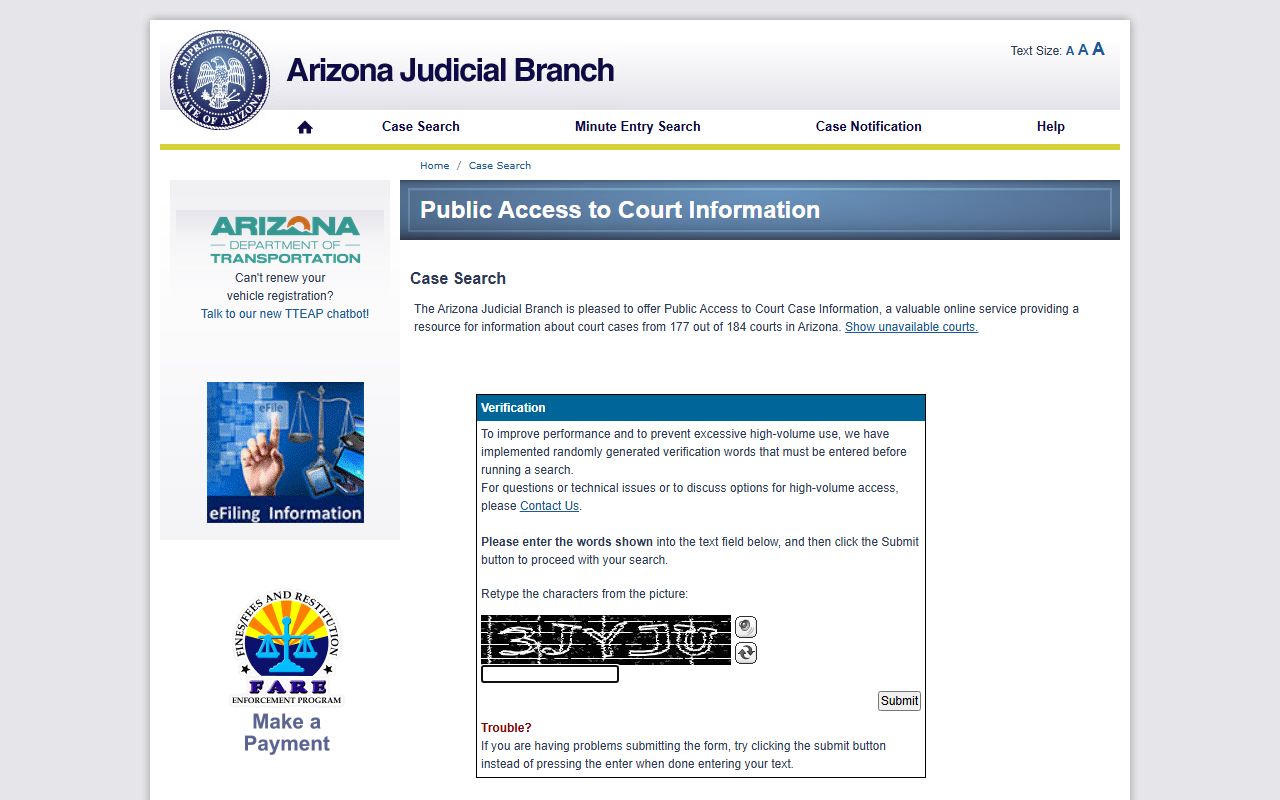
Use the weekly update notice when a case does not appear right after booking. A missing entry does not always mean no charges will be filed.
Coconino County Court Case Fields
The Arizona Public Access search inspection found a verification screen before the search fields. The visible and captured field details help narrow Coconino County court records after a jail arrest without guessing at the wrong court. Coconino cases may be in Superior Court, Flagstaff Justice Court, Flagstaff Municipal Court, Page Justice Court, Page Municipal Court, Fredonia courts, Williams courts, or another Arizona court depending on the charge and arrest location.
| Field Label | Type | Required | Options or Notes |
|---|---|---|---|
| Verification / CAPTCHA text | Text | Yes before search | Retype the characters from the picture, then submit. |
| Last Name or Business Name | Text | Likely required for name search | Validation asks for a last name or business name. |
| Case Number | Text | Optional if searching by case | Validation gives an example format such as CV-200812345. |
| Year | Dropdown | Optional filter | Captured options ran from 2026 back through 1916. |
| Court | Dropdown | Optional filter | Includes Coconino Superior, justice, and municipal courts. |
eAccess is different from the public case index. It provides online access to Arizona Superior Court civil and criminal case records filed on or after July 1, 2010, subject to access exceptions for sealed, closed, or protected documents. An index entry can confirm a case exists, while eAccess may provide document access when rules permit.
Coconino County Arrest Charging Documents
Formal charges after a Coconino County arrest are filed through charging documents. The Coconino County Attorney leads prosecution for county criminal matters, and the official directory lists a charging team, felony prosecution, misdemeanor team, juvenile justice, and diversion work. The filing document matters because it tells the court what accusation is being pursued. It may not match the first jail booking label word for word.
| Document | Who Files or Issues It | Common Use | Why It Matters |
|---|---|---|---|
| Complaint | Officer or prosecutor | Many misdemeanor, citation, and early criminal filings | Often starts the case after arrest or citation. |
| Information | Prosecutor | Many felony prosecutions after review | States the formal charge the prosecutor chose to file. |
| Indictment | Grand jury | Serious or grand-jury felony matters | Shows a grand jury found probable cause to charge. |
The Coconino County Attorney directory names County Attorney Ammon Barker and shows prosecution teams tied to charging and felony or misdemeanor case work. That office role is why court records after a jail arrest can differ from the charge wording used at booking.
Coconino County Charge Status
Charge status is the best place to read the case after the first filing. A case can begin with one set of charges, then change as the prosecutor reviews evidence, plea talks occur, a diversion path opens, or a judge rules on motions. Coconino's jail report makes the same point from the jail side by warning that booking charges do not imply disposition and may be dropped, modified, or added through the legal process.
| Status | What It Means |
|---|---|
| Pending | The charge is active and has not reached final disposition. |
| Amended | The charge wording, level, or count has been changed by filing or court action. |
| Reduced | The filed charge was lowered to a less serious offense or count. |
| Dismissed | The charge was ended by the court or prosecution and did not produce a conviction. |
| Diversion | The case may be routed to a program path instead of ordinary prosecution, when eligible. |
| Convicted | The charge resulted in a guilty plea, verdict, or other conviction entry. |
Note: A jail release does not always close the court case, and a court dismissal does not always erase every public record.
Bond After Coconino County Arrest
Bond and release conditions after a Coconino County arrest are generally set through the court process. County pages reviewed did not publish a full local bond-payment schedule, but the jail FAQ routes bond questions through the Flagstaff detention phone line at 928-226-5200. The jail can help with current custody and may be able to give bond status, while the court record controls the formal release terms.
| Bond or Hold Type | How It Works |
|---|---|
| Cash bond | Money is posted with the court or jail authority to secure appearance. |
| Surety bond | A licensed bail bond agent posts bond for a fee or collateral agreement. |
| Personal recognizance | Release is based on a promise to appear and follow court conditions. |
| No-bond hold | Payment alone will not release the person. |
| Other-agency hold | Release depends on another warrant, detainer, court commit, or federal hold. |
Multiple holds can make a case look confusing. A person may post bond on one Coconino County charge yet remain in custody for a warrant, remand, court commit, or U.S. Marshals hold. Court records after a jail arrest should be read with the jail custody status, not in place of it.
Coconino County Arrest Warrants
Coconino County's official warrant-tips page does not publish a separate sheriff warrant database. It directs users to Public Access to Arizona Court Information for court cases and warrants. That makes the Arizona Public Access case lookup the first online warrant check for many Coconino County court records after an arrest. Local justice and municipal courts may handle many bench warrants tied to traffic, misdemeanor, city, or local cases.
For tips on crimes or wanted persons, the county lists dispatch at 800-338-7888, option 1, and Coconino County Silent Witness at 928-774-6111. These tip lines are not a case-record substitute. A person trying to clear or appear on a warrant should use the court named on the paperwork, an attorney, or the proper law-enforcement contact instead of relying on unofficial aggregator entries.
Coconino County Charges vs Convictions
Public court records after a jail arrest often show charges before there is any final result. A charge is an accusation. A conviction is a final outcome such as a guilty plea or verdict. Some charges are dismissed. Some are amended or reduced. Others are resolved through diversion, plea, trial, or sentencing. Reading the disposition field is as important as reading the charge name.
| Point | Charge | Conviction |
|---|---|---|
| Stage | Accusation filed or listed in the case | Final guilty plea, verdict, or qualifying judgment |
| Proof Level | Based on probable cause or prosecutor filing decision | Requires proof beyond a reasonable doubt or a valid plea |
| Record Meaning | Shows what was alleged | Shows what was finally found or admitted |
| Can Change | May be amended, reduced, added, or dismissed | May be appealed, set aside, or sealed only through legal process |
Sealed Coconino County Arrest Records
Arizona uses sealing rules that can restrict public access to qualifying arrest, conviction, and sentencing records. A.R.S. 13-911 allows a person to petition to seal records after certain dismissals, acquittals, no-file arrests, or completed conviction and waiting-period scenarios. Sealing is court controlled. It does not mean a record was never created, and it does not promise that every copy held by every public or third-party system disappears at once.
| Issue | Sealed | Expunged |
|---|---|---|
| Arizona focus | Public access is restricted by court order under rules such as A.R.S. 13-911. | Common term for removal or destruction, but not the usual label for Arizona adult sealing relief. |
| Visibility | Hidden or limited for ordinary public searches when the order applies. | Depends on the specific legal authority and record type. |
| Law enforcement | May retain access in allowed circumstances. | Access depends on the statute and order. |
| Eligibility | Depends on disposition, offense type, sentence completion, waiting period, and court ruling. | Should not be assumed from dismissal alone. |
Juvenile matters, protected victim information, sealed filings, confidential records, and ongoing-investigation material may be restricted even when other parts of the case are public. eAccess also excludes sealed, closed, or otherwise protected cases or documents from ordinary online access.
Coconino County Court Record Laws
Arizona public-records law supports access to many government records, but court rules and statutory exceptions shape what can be viewed or copied. A.R.S. 39-121 says public records in an officer's custody are open to inspection during office hours. A.R.S. 39-121.01 requires public bodies to maintain records of official activities and furnish copies subject to the public-records article and applicable fees.
A.R.S. 31-221 covers ADCRR master record files and prisoner care and custody records, with exceptions for safety, ongoing investigations, and confidential informants. A.R.S. 13-911 is the sealing statute most relevant when a person asks why an arrest or court case no longer appears in a public search. For court records after a jail arrest, the correct answer can depend on both public-record law and court access rules.
Restricted Coconino County Court Records
Not every court record after a jail arrest will be visible through a public search. Juvenile cases, sealed criminal matters, protected case documents, victim information, some dismissed or restricted records, and active investigative material may have limits. The Coconino Clerk page says the office processes juvenile and other protected case types, which means some records require clerk review rather than a simple public index lookup.
Background check use also has limits. Public court search data should not be treated as a consumer report for employment, housing, credit, insurance, or other FCRA-covered decisions unless the process meets all required law. For personal case research, verify charge status, disposition, and sealing status with the court that created the record.
Important: Court records after an arrest can lag behind jail booking, and a charge is not a conviction.